How to Use Agentic AI to Automate Your Business Operations — Where to Start
Most businesses are genuinely interested in AI automation — they just don't know where to start. Not because the technology is unclear, but because nobody has walked them through what it actually looks like to implement it inside a real company, with real staff and real data.
2–4 weeks
typical time from scoping to a live single-workflow automation with clean, consistent data
0%
accuracy threshold where review-based automations become immediately useful — no 100% required
1–3 months
average payback period for a well-scoped automation against the staff hours it replaces
AI automation projects don't usually fail because the technology doesn't work. They fail because the starting point was wrong — too complex, too broad, or built on data that wasn't ready. By month three or four, a significant amount of time and money has been spent with nothing actually running yet.
The businesses that make real progress with AI automation share one thing in common: they started small. One workflow, well-scoped, clean data. Got it working in 2 to 3 weeks. Then did it again. That's not a limitation — it's the strategy.
Why Getting the Starting Point Right Matters More Than Anything Else
The right first automation isn't necessarily the most impactful one. It's the one most likely to work cleanly and quickly — which builds confidence and proves the model before you stake anything bigger on it. Starting with a contained, well-understood workflow means you see results in weeks, not quarters, and you have something concrete to show the rest of the team.
When a business tries to automate too much too soon, scope expands as more stakeholders get involved, data preparation takes far longer than expected, and momentum stalls before anything ships. Pick small. Win fast. Then scale what works.
How to Find the Right First Automation in Your Business
Three questions help identify it. First: what does someone on your team do every single day that takes 30–90 minutes and follows a consistent pattern? Consistency in the input is what determines how reliably AI can handle a task. Workflows where inputs follow a predictable format — same document type, same data structure, same email format — are where automation performs well from day one.
- Processing supplier invoices where the format is consistent
- Extracting action items from meeting recordings
- Classifying inbound support requests by type and urgency
- Compiling weekly data from multiple sources into a single report
- Drafting first-response emails to a predictable category of enquiry
Second: what happens if the AI gets it 80% right — is that still useful? Some tasks need 100% accuracy or they create more problems than they solve. Others work fine at 80% because a human reviews the output anyway. Knowing which category your task falls into before you start saves a lot of frustration. Tasks where 80% is genuinely useful are almost always the better starting point.
Third: who owns this task, and will they actually use AI-assisted output? This is the question that determines whether an automation gets adopted or quietly abandoned. Pick a task where the person responsible will be genuinely relieved to have help — not one where AI-assisted output might feel like a threat to their role. The difference between those two situations is the difference between an automation that runs and one that gets ignored.
The right first automation isn't the most ambitious one. It's the one that works cleanly, builds confidence, and proves the model — in 2 to 3 weeks.
What 'Agentic' Actually Means — and Why It Matters Here
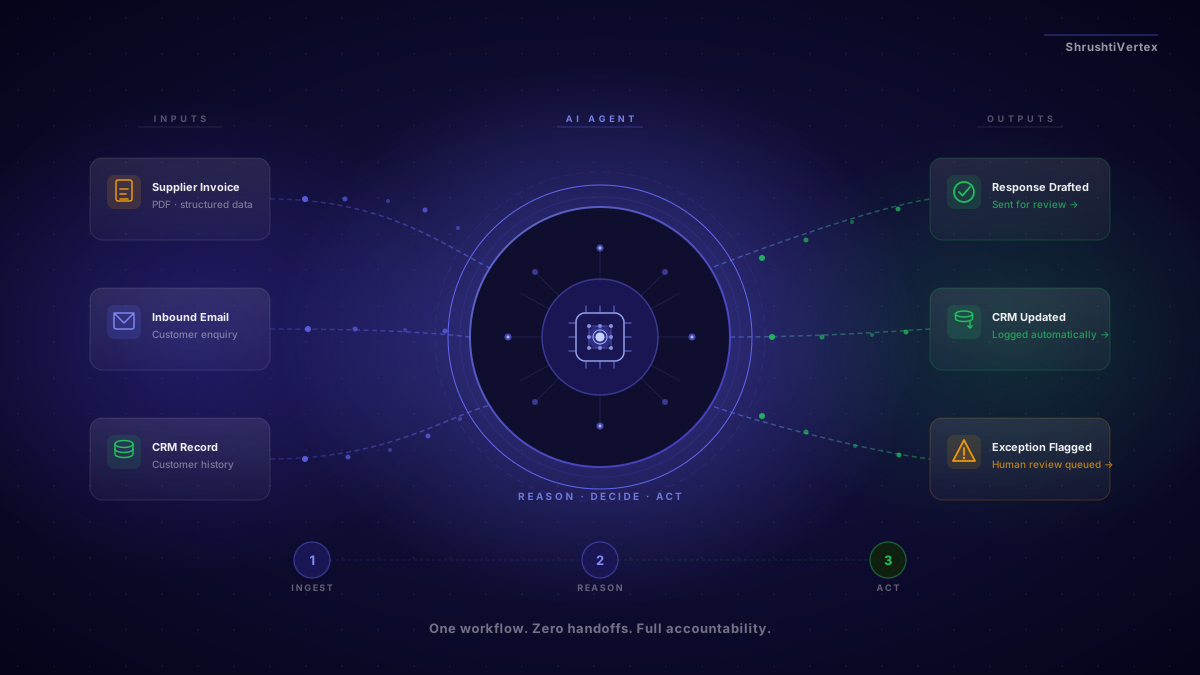
A basic chatbot answers questions. A rule-based automation follows a fixed script: if X happens, do Y. Agentic AI is different because it can reason through a multi-step task, decide what to do next based on what it finds, and take action across different tools — without a human directing each step.
In practice, agentic AI can open an email, read an attachment, cross-reference it against data in a spreadsheet or CRM, draft a response, log the interaction, and flag anything that needs human review — as a single connected workflow, not a series of separate manual steps.
That's why a well-scoped first workflow matters so much. Give agentic AI a clear, contained problem and it performs reliably. Add too many variables too early and you create the kind of complexity that takes weeks to untangle. The architecture decisions that seem small at the start — what data goes in, what output looks like, what needs human review — determine whether an automation runs for two years or gets rebuilt from scratch in six months.
Related Service
Agentic AI Development
From scoping to production — we help you identify the right workflows, prepare your data, and build automations that run reliably without constant oversight.
The Financial Case Most Businesses Forget to Make
Automating a workflow isn't just an operational decision — it's a financial one, and the numbers are usually more straightforward than people expect. Consider a 3-person operations team each spending 90 minutes a day on manual invoice processing. That's 4.5 hours a day, roughly 90 hours a month across three salaries. Put a real number on those hours — even a conservative estimate — and you have a baseline. That's what the automation needs to beat, and for a well-scoped project it usually does within 1 to 3 months.
0 hrs/mo
staff time replaced in a typical 3-person, 90-min/day workflow — before accounting for what that time is now spent on instead
1–3 months
average payback period when automation replaces a single well-scoped manual workflow
After payback, you're running on recovered time. In a small team, that's not an abstraction — it's the difference between your operations manager spending their day processing paperwork or spending it on the work that actually moves the business forward.
The ShrushtiVertex Perspective
There's another financial dimension worth thinking through: when you automate a repetitive task, the real value isn't just the time saved on that task — it's what the person doing it can now focus on instead. That shift rarely shows up on a project invoice, but it shows up in business output over the following 12 months. This is the kind of calculation that sits at the intersection of your technology decisions and your business strategy — and it's a conversation worth having with someone who understands both sides. The article on why growing businesses need a technology partner — not just a vendor — explains why keeping these decisions separate tends to cost more in the long run.
The Gap Is Smaller Than Most People Think
The distance between 'we're evaluating AI' and 'AI is actually running in our business' isn't a technology gap. It's a starting point gap. The businesses that are ahead right now picked one small workflow that was taking up time nobody could afford. They got it working. They showed the team. Then they picked the next one.
If you've already identified the task that's been on the list for months because there's never enough time to deal with it — that's your starting point.
The technology is ready. The question is only where to begin. We can scope your first automation in a single conversation — no proposal until you want one.
Related Service
Scope Your First Automation — No Commitment
Tell us about the workflow you have in mind. We'll give you an honest assessment of complexity, timeline, and ROI in one conversation — before any budget discussion.
Frequently Asked Questions
For a well-scoped single workflow — one clear input, one clear output, consistent data — expect 2 to 4 weeks from scoping to live. Most of that time is spent on data preparation and testing, not the build itself. A realistic timeline upfront is the sign of a well-run project.
No. A well-built automation produces output that looks like something a capable colleague created — not a system output that requires interpretation. If staff regularly have to work around errors or second-guess the output, that's a signal the automation needs refinement, not that automation itself is the wrong call.
It varies with complexity, but a single focused automation — one workflow, clean scope, good data — typically costs less than one month of the staff time it replaces. The ROI calculation becomes obvious once you put a real number on what those hours currently cost.
A basic automation follows a fixed script: if X happens, do Y. Agentic AI can reason through a multi-step task, decide what to do next based on what it finds, and take action across different tools — without a human directing each step. In practice, it handles connected multi-step workflows end-to-end, not just individual trigger-response actions.
Three signals: the task happens daily or weekly and follows a consistent pattern; the inputs have a predictable format (same document type, same data structure); and the person doing it would be genuinely relieved to have help rather than threatened by it. If all three are true, it's a strong candidate.
About the Author
Shrushtivertex
Shrushtivertex is a technology engineering company helping startups and enterprises build scalable cloud infrastructure, AI solutions, web applications, mobile apps, and blockchain platforms.
Newsletter
Stay Ahead of Technology
One practical engineering insight every month. No noise, no spam.
Related Articles
 Digital Transformation7 min read
Why Every Modern Business Needs a Technology Partner—Not Just a Software Development Company
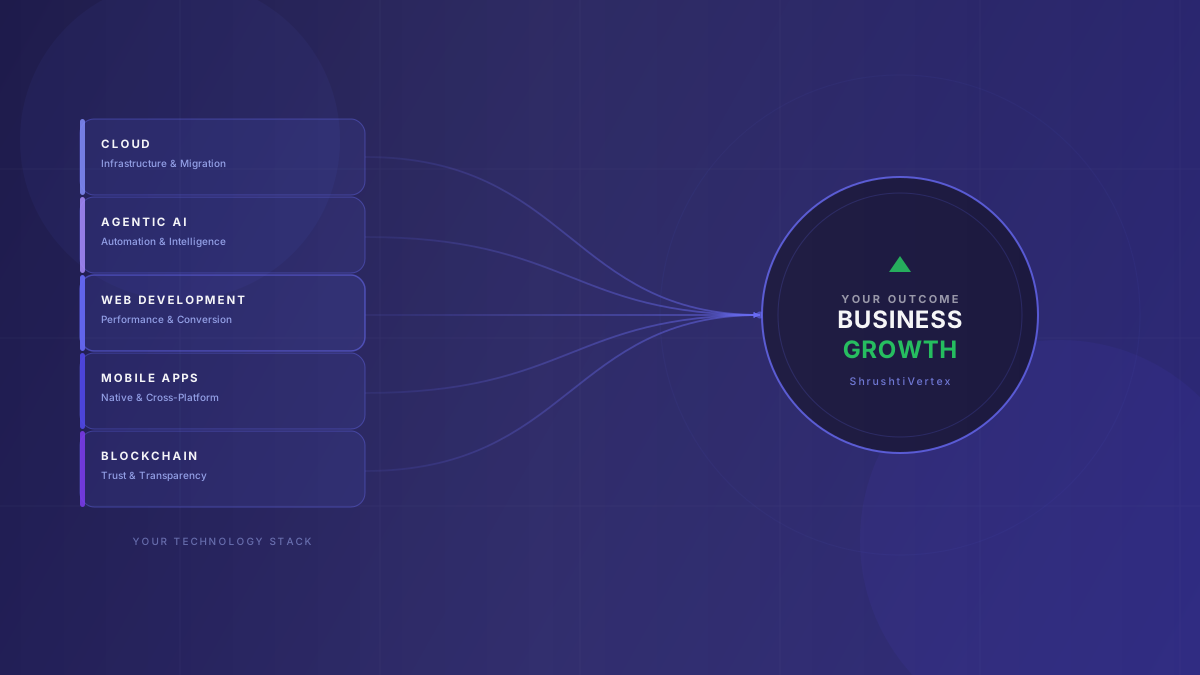
The gap between a software vendor and a true technology partner is strategic, not technical. Here's why that distinction defines how fast your business grows in the next decade.
Read article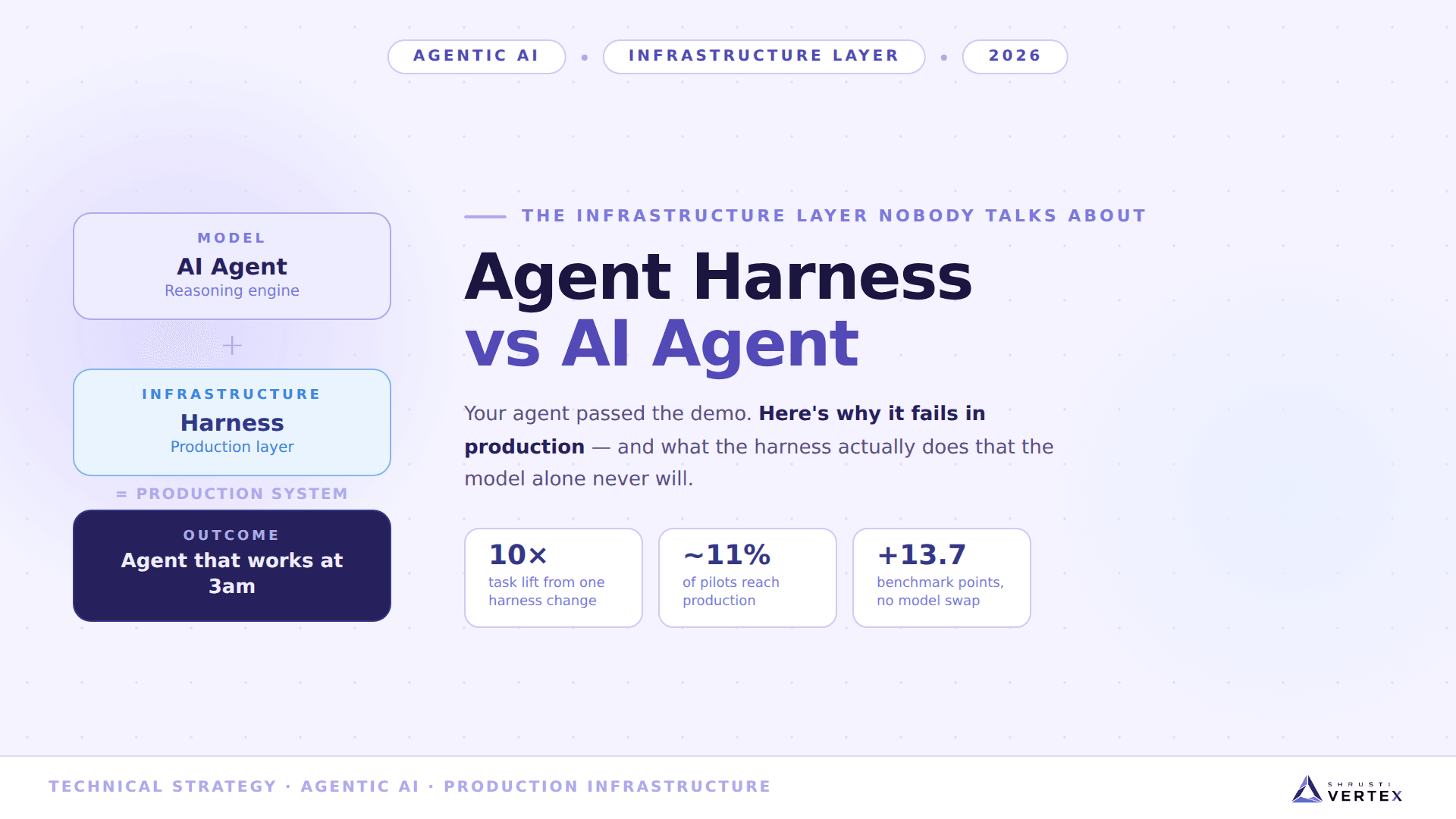 Agentic AI10 min read
Agent Harness vs AI Agent: Why Your AI Build Fails in Production (And How to Fix It)
Your agent passed the demo. Three weeks into production it's marking tasks complete that aren't finished, losing context between sessions, and nobody can reproduce the failure — because the bug isn't in the agent. It's in what you built around it.
Read article AI & Automation9 min read
AI Automation for Small Business: What to Automate First
Most AI automation guides list what to automate. This one covers what actually works, what breaks quietly, and what the real costs are before you commit.
Read article