Agent Harness vs AI Agent: Why Your AI Build Fails in Production (And How to Fix It)
Your agent passed the demo. Three weeks into production, it's marking tasks complete that aren't finished, losing context between sessions, and nobody on your team can reliably reproduce the failure — because the bug isn't in the agent. It's in what you built around it.
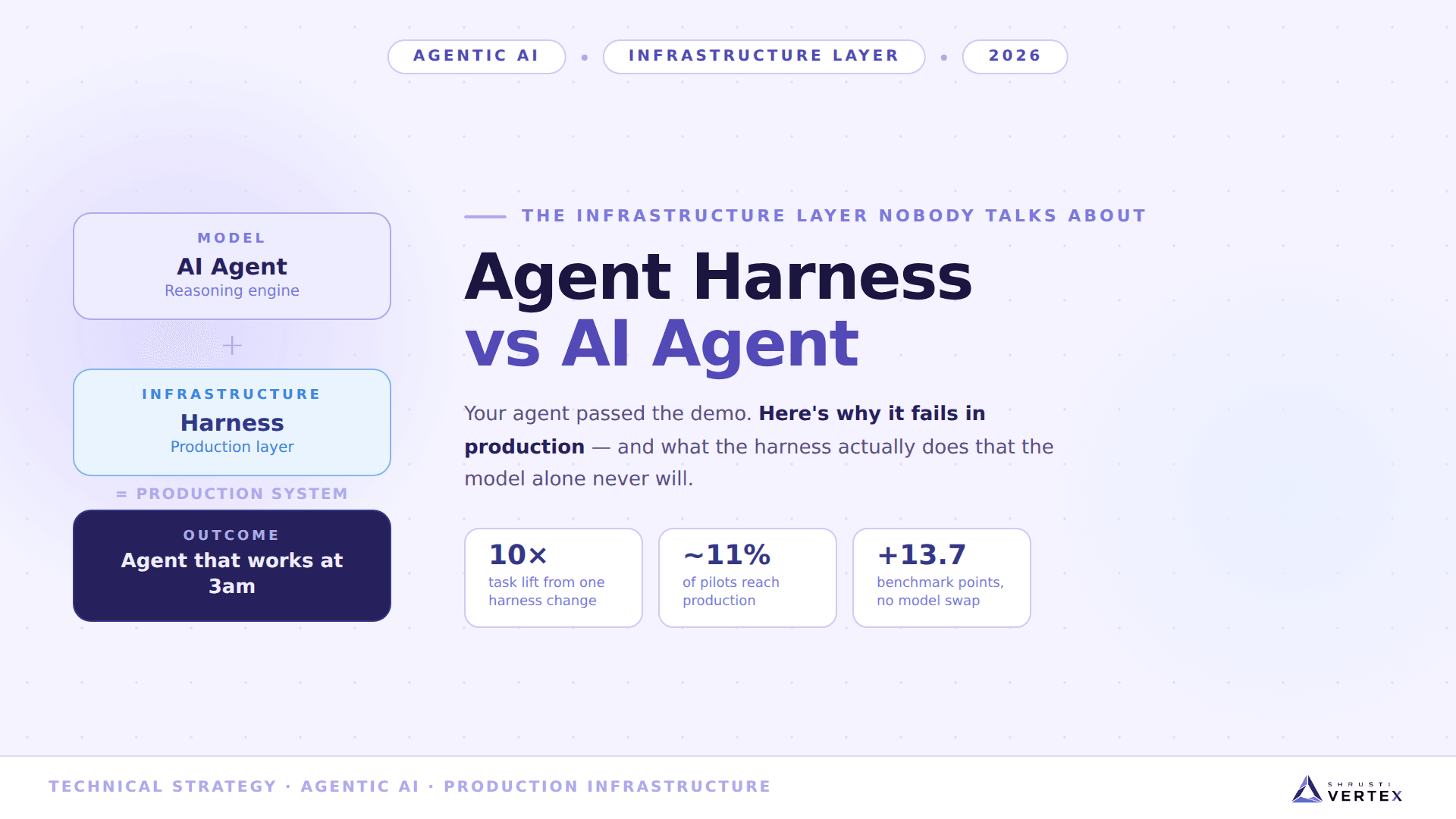
13.7 pts
benchmark improvement from harness changes alone — with the model held completely fixed (LangChain, 2026)
6.7% → 68.3%
task completion jump from changing only the tool call structure — one harness-level detail (Can Bölük, 2026)
11–14%
enterprise AI agent pilots that reach organisation-wide production — harness failures are the leading cause of the rest
The model didn't change. The model is fine. What's missing is a harness — and this article explains exactly what that means, why it matters more than your model choice, and what to look for before you build or commission any agentic AI system.
What an AI Agent Actually Is — and What It Cannot Do on Its Own
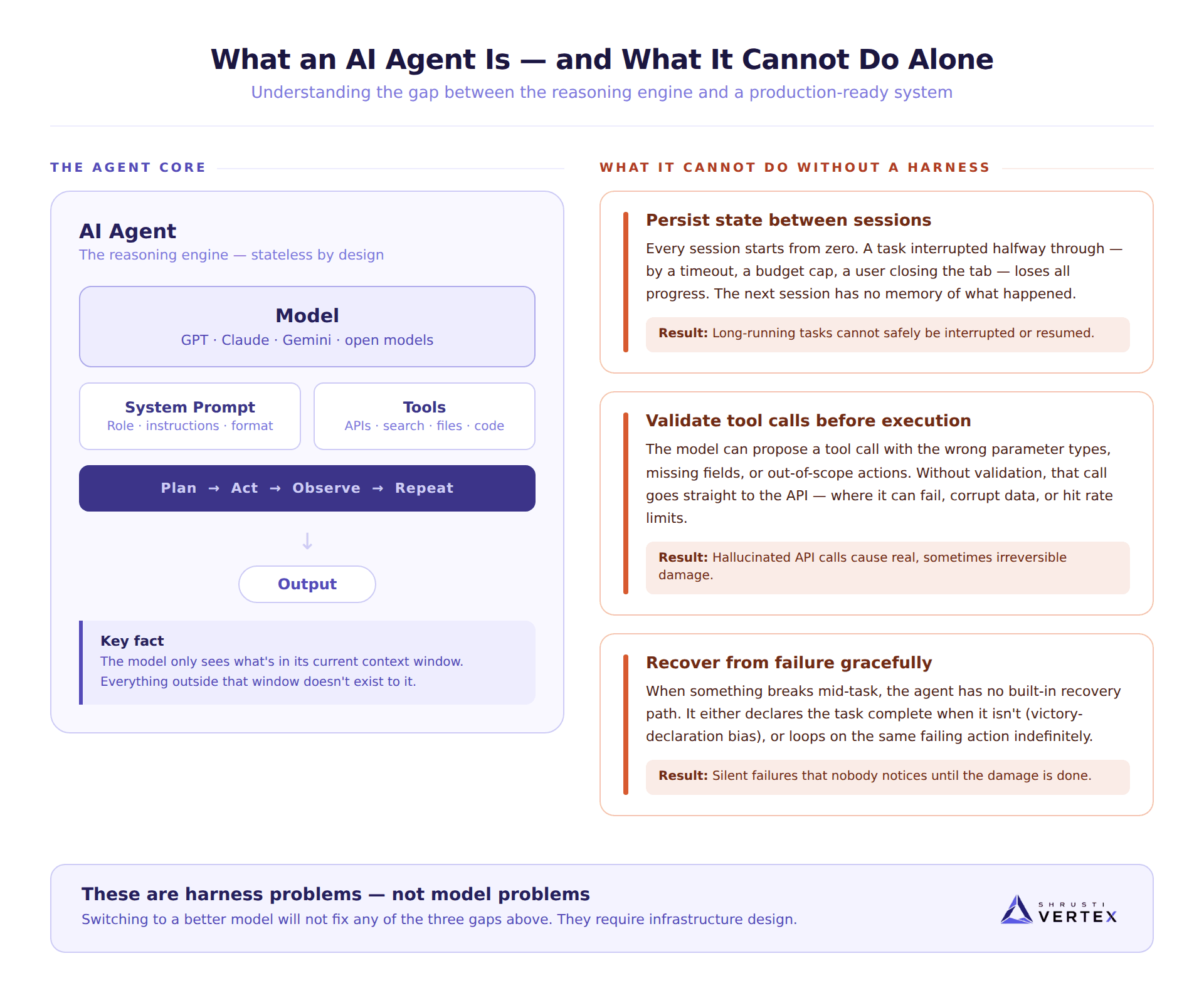
An AI agent is a system that takes a goal, plans how to reach it, uses tools to take action, observes the results, and repeats the loop until the task is done. At its core: a model, a system prompt, and a set of tools it can call — a web search, a database query, a file write, an API. That sounds complete. It isn't.
The model at the centre of any agent is stateless. It doesn't remember last Tuesday's session. It doesn't know whether the tool call it made three steps ago actually worked. It doesn't have a built-in alarm that fires when it's been running in circles for twenty minutes. Each time the model produces an output, it's working purely from what's in its current context window — which means anything outside that window doesn't exist to it.
This isn't a flaw you can patch with a better prompt. It's the fundamental nature of how language models work. Everything the model can't do — remembering, recovering, verifying, staying within budget, knowing when to stop — has to come from somewhere else. That somewhere else is the harness.
A CPU is one of the most powerful pieces of technology ever built — but in an empty box with no operating system, it does nothing useful. The model is the CPU. The harness is the operating system that makes it functional in the real world.
What an Agent Harness Actually Is — Six Layers the Model Cannot Provide
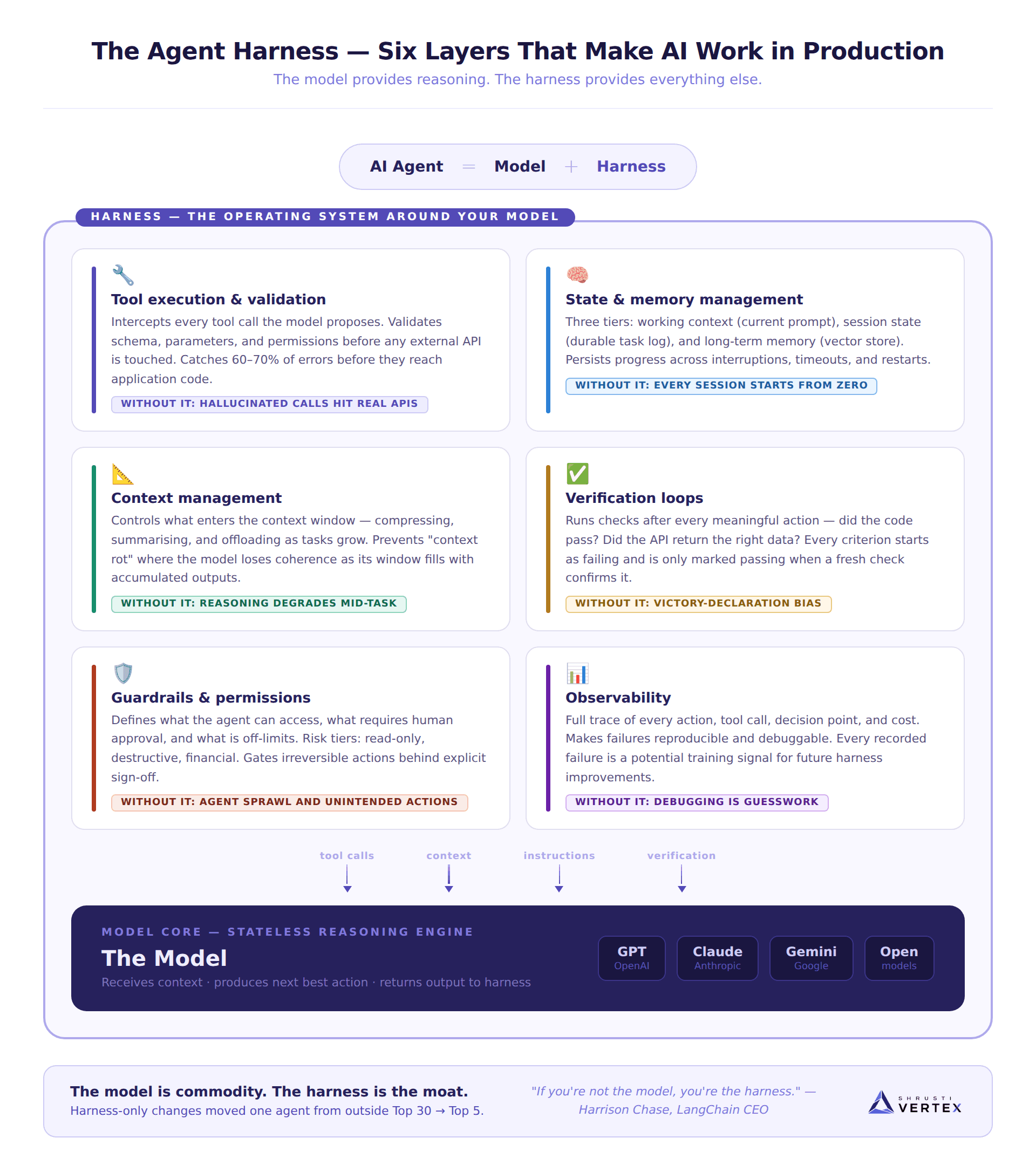
The harness is everything that is not the model. It's the layer that wraps around the reasoning core and turns it into something that can run reliably, safely, and repeatably in production. LangChain CEO Harrison Chase put it as cleanly as anyone has: "If you're not the model, you're the harness." By early 2026, the teams that had actually shipped production agentic systems were saying something different from the 2024 model-obsession: the model is increasingly commodity. The difference between a demo that impresses and a system that works at 3am on a Tuesday is the harness.
- Tool execution and validation — intercepts every tool call before it reaches an external system, validates schema, types, and allowed scope. Catches 60–70% of errors before they reach application code.
- State and memory management — working context (current prompt), session state (durable task log), and long-term memory (vector store across sessions). Without this, every interruption means starting over.
- Context management — decides what goes into the context window and what gets compressed or offloaded. Anthropic's experiments showed well-designed context management cut token consumption by 84% while improving task completion on long-running workflows.
- Verification loops — after each meaningful action, checks whether it actually worked. Without this, agents fall into 'victory-declaration bias': marking a task complete because they believe the work is done, even when a basic check would show otherwise.
- Guardrails and permissions — defines what the agent can access, what requires human approval, and what is off-limits entirely. Without this, one loose authorisation decision cascades into a system that can do far more than anyone intended.
- Observability — every action, tool call, and decision point logged and traceable. Not because something will definitely go wrong — but because when it does, you need to know exactly where the failure happened and how to prevent it next time.
The Formula That Changes How You Think About AI Investment
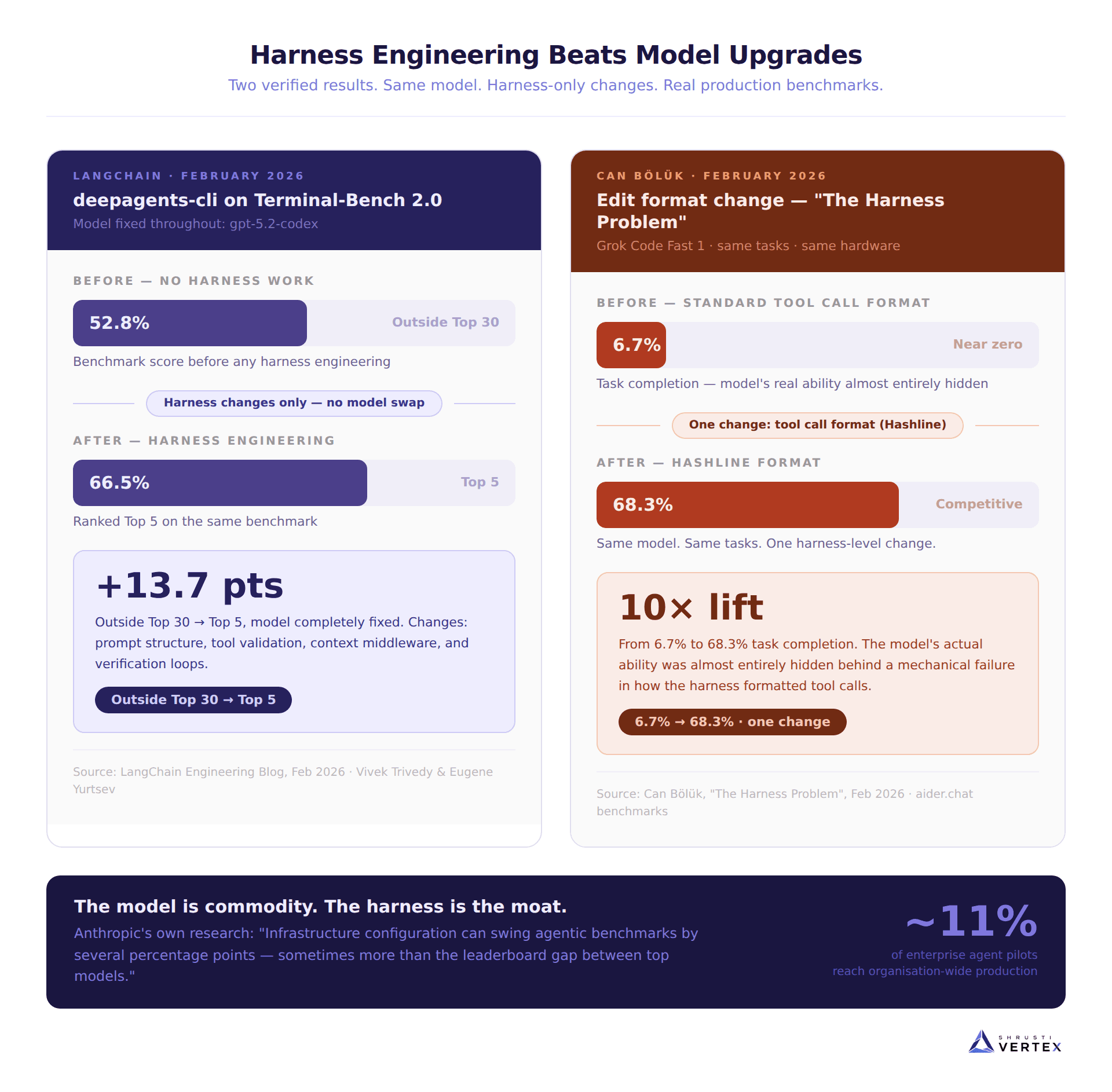
In early 2026, LangChain published results from an experiment that should reshape where any technical leader spends their AI engineering budget. Their team held the underlying model completely fixed and changed only the harness: system prompt structure, tool validation logic, verification middleware, context management approach. The agent went from outside the top 30 on a standard benchmark to top 5. A 13.7-point improvement. No model change.
Researcher Can Bölük published a finding that's even more striking. He changed only the format of how tool calls were structured — one harness-level detail — and a single model's task completion rate went from 6.7% to 68.3%. Tenfold. The model's actual capability hadn't changed at all. It had been almost entirely hidden behind a mechanical failure in how the harness was passing instructions.
The ShrushtiVertex Perspective
The strategic implication is clear. If you're evaluating two models and one scores 3 points higher on a benchmark, that gap almost certainly disappears after 50 real tool calls in a production environment. Model quality is a depreciating advantage. Harness quality compounds over time — every failure you diagnose and fix makes the system more reliable, and that improvement doesn't evaporate when a new model version ships. Most teams right now are over-investing in the model and under-investing in the harness.
Agent = Model + Harness. The model provides the reasoning. The harness provides everything that makes that reasoning useful in the real world.
Where Does MCP Fit in All of This?
MCP — Model Context Protocol, the open standard introduced by Anthropic — is often described as 'USB-C for AI.' It standardises how a harness connects to external tools — databases, APIs, file systems, web browsers — so you don't have to write custom integration code for every tool your agent needs. But MCP is not the harness. It's one component that a harness can use.
Teams sometimes assume adopting MCP solves their production reliability problems. It doesn't. MCP handles the standardisation of the tool connection. The harness still has to validate that the model's proposed tool call has the right schema. The harness still has to enforce permissions and handle what happens when an MCP tool returns an error — whether to retry, rephrase, use a different tool, or escalate to a human.
MCP is a well-standardised power socket. The harness is the building's electrical system — the wiring, the circuit breakers, the safety controls. You need both. The socket alone doesn't stop the building from burning down.
Three Questions to Ask Before Any Agentic AI Build
Whether you're evaluating a vendor, reviewing an internal proposal, or deciding whether to build or buy — these three questions surface harness gaps faster than any technical deep-dive.
"How does your system handle state when a session is interrupted mid-task?" This separates teams that have thought about production from teams that have only thought about demos. A production agent gets interrupted — by timeouts, budget caps, unexpected inputs, a user who walks away. If the answer is vague or defensive, the harness doesn't have durable state management. Every interruption means starting over.
"Show me your tool validation layer — what happens before a tool call reaches the API?" If the vendor doesn't have a clear answer — if tool calls go straight from model output to execution — you're one bad prompt away from an expensive or destructive mistake. This is where 60–70% of production failures originate.
"What does failure look like in your design — and how does the system recover without a human restarting it?" This is the question most vendors least want to answer. A well-designed harness has documented failure modes, defined recovery paths, and monitoring that alerts before a failure cascades. If the vendor hasn't thought about this, they've built a demo, not a production system.
The Model Is the Starting Point. The Harness Is the Product.
Only 11–14% of enterprise AI agent pilots have reached organisation-wide production. The failure usually isn't the model — it's state management that breaks on interruption, tool calls that fail silently, verification that never ran, guardrails that were an afterthought. Those are harness failures. And they're all fixable with the right design from the start.
2025 proved that AI agents could do impressive things. 2026 is proving that making them work reliably is a different problem entirely — one that has very little to do with model capability and almost everything to do with the infrastructure wrapped around it. If you have an agent in production — or are about to commission one — a short architecture review usually surfaces the harness gaps before they become production problems.
Related Service
Free Agentic AI Architecture Review
A 30-minute architecture review surfaces harness gaps before they become production problems. No pitch — just an honest look at what's there and what needs attention.
Frequently Asked Questions
No, and the distinction matters. A framework — LangChain, LangGraph, CrewAI — is what you build with. A harness is what you deploy: the specific production runtime that executes your agent with its particular tools, state management, verification logic, and guardrails. You often use a framework to build a harness, but using LangChain doesn't mean you have a harness — it means you have a starting point.
It depends on how much of the agent loop is your actual product. If the agent's behaviour, decision-making, and tool use are core to your value proposition, you probably want a custom harness. If the agent is more of an internal tool, managed harness platforms like AWS Bedrock AgentCore handle orchestration, state, and observability for you. The tradeoff is control vs. speed — neither is always right.
Yes. The LangChain and Can Bölük results referenced in this article were run with frontier models — the best available. They still showed 10× performance differences based purely on harness design. A better model with a bad harness still fails in production. A good harness with a decent model often beats a great model with a broken one.
For a single-turn agent — one input, one output, no multi-step task — you may not need much of a harness at all. A well-designed system prompt and basic output validation might be sufficient. The harness becomes critical when tasks span multiple steps, involve external tool calls, run for minutes or hours, or have consequences that are hard to reverse. The more any of those are true, the more harness investment pays off.
About the Author
Shrushtivertex
Shrushtivertex is a technology engineering company helping startups and enterprises build scalable cloud infrastructure, AI solutions, web applications, mobile apps, and blockchain platforms.
Newsletter
Stay Ahead of Technology
One practical engineering insight every month. No noise, no spam.
Related Articles
 Digital Transformation7 min read
Why Every Modern Business Needs a Technology Partner—Not Just a Software Development Company
The gap between a software vendor and a true technology partner is strategic, not technical. Here's why that distinction defines how fast your business grows in the next decade.
Read article Agentic AI8 min read
How to Use Agentic AI to Automate Your Business Operations — Where to Start
Most businesses are interested in AI automation — they just don't know where to start. This guide shows you how to find the right first workflow, make the financial case, and build confidence before you scale.
Read article AI & Automation9 min read
AI Automation for Small Business: What to Automate First
Most AI automation guides list what to automate. This one covers what actually works, what breaks quietly, and what the real costs are before you commit.
Read article